 Late Payment
Free UK invoice template, ready for late payers
A spreadsheet invoice with every detail GOV.UK says an invoice must include, a due date that works itself out, and a pre-written line about statutory interest. If the client pays late, a second sheet shows what you can claim.
Download the template
Excel .xlsx (about 12 KB). Opens in Excel, LibreOffice and Google Sheets (File, Import). No sign-up, no email.
Download the free invoice template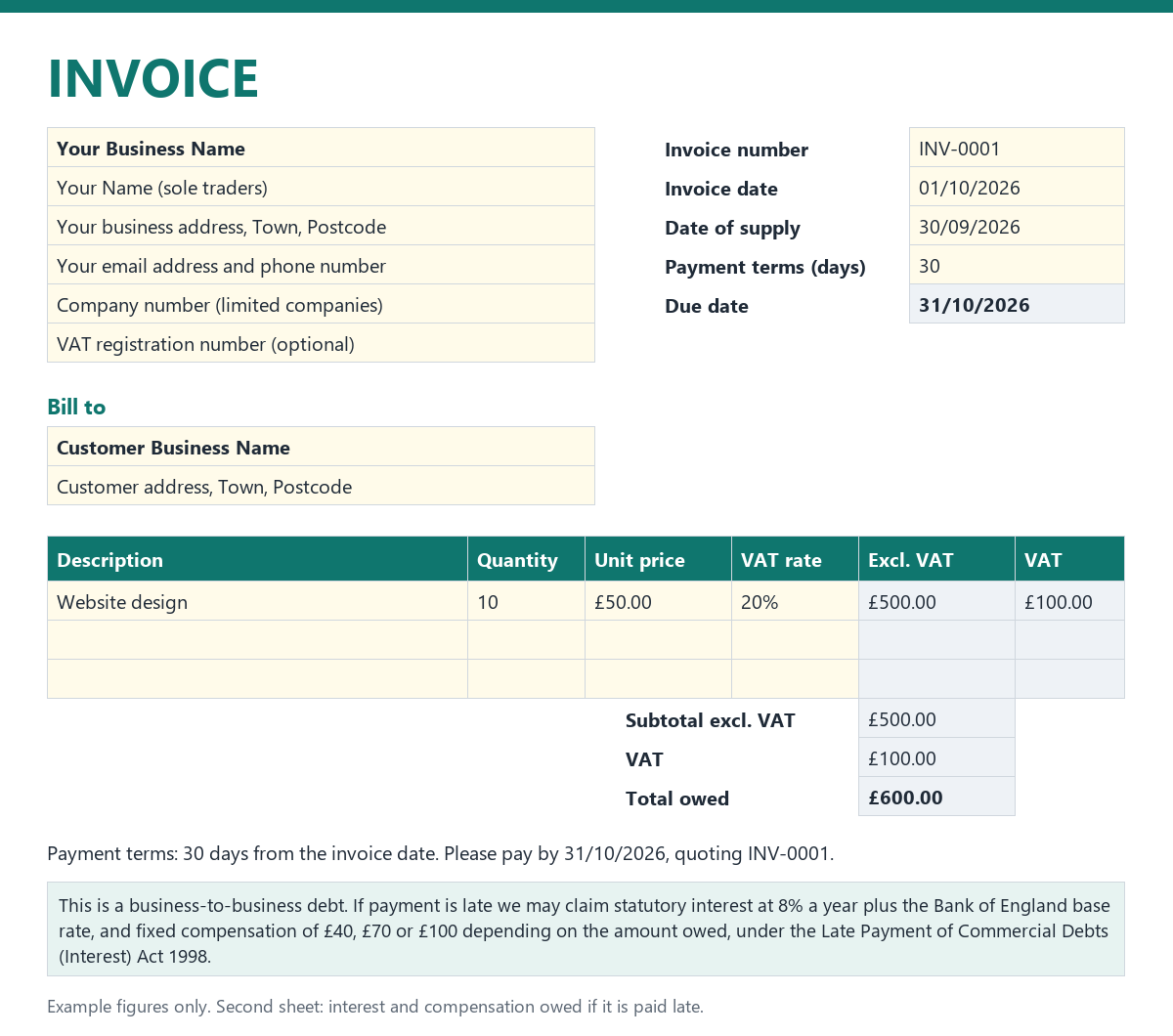
What's in it
- Invoice sheet: your details, the customer's, invoice number, invoice date, date of supply, payment terms in days and a due date = invoice date + terms, eight lines with quantity, unit price and an optional VAT rate, and totals.
- Late payment line, ready written: if payment is late you may claim statutory interest at 8% a year plus the Bank of England base rate, and fixed compensation of £40, £70 or £100, under the Late Payment of Commercial Debts (Interest) Act 1998.
- "If paid late" sheet (for you, not the client): days overdue as of today, interest at 8% plus the reference rate you enter, the fixed compensation band and the new total.
- Placeholder text only. Yellow cells are yours; grey cells calculate.
What GOV.UK says an invoice must include
According to GOV.UK, every invoice must show:
- a unique identification number
- your company name, address and contact information
- the company name and address of the customer you're invoicing
- a clear description of what you're charging for
- the date the goods or service were provided (supply date)
- the date of the invoice
- the amount(s) being charged
- the VAT amount, if applicable
- the total amount owed
Sole traders must also show their own name and any business name, and an address where legal documents can be delivered if they use a business name. Limited companies must use the full company name as it appears on the certificate of incorporation, and if they name any directors they must name all of them. The template has a yellow cell for each. More on invoice requirements →
If you're VAT registered
If you and your customer are both VAT registered, you must issue a VAT invoice. HMRC's VAT Notice 700 (paragraph 16.3.1) adds details such as your VAT registration number, the time of supply (tax point), the VAT rate for each item and the total VAT in sterling. The template's VAT fields are optional: fill in the rate for each line and your VAT number, or leave them blank if you're not registered.
How the late payment sheet works it out
- Days overdue: today minus the due date. A payment is late from the day after it was due.
- Rate: 8% plus the reference rate: the Bank of England base rate on 31 December (for payments that became late 1 January to 30 June) or 30 June (1 July to 31 December). It's 3.75% for payments that became late from 1 July 2026 to 31 December 2026, so 11.75% a year. You enter it, because it depends on when the payment became late.
- Interest: amount owed × rate ÷ 365 × days overdue. £2,400 at 11.75% for 40 days is £30.90.
- Compensation: £40 up to £999.99, £70 from £1,000 to £9,999.99, £100 from £10,000, once per invoice.
This applies to business clients only, not consumers. If your contract sets its own late-payment rate, that rate applies instead. GOV.UK says to send a new invoice if you decide to add interest. Check any date with the calculator → · How to chase an unpaid invoice →
Want the reminder letters too? The UK Freelancer Contract Pack (£18.00 including VAT) has a friendly reminder, firm reminder and final notice citing the 1998 Act. The invoice template here is free either way.
Official sources
- GOV.UK: Invoices — what they must include
- HMRC: VAT Notice 700, 16.3 Information required on a VAT invoice
- GOV.UK: Interest on late commercial payments
- GOV.UK: Claim debt recovery costs
- Bank of England: Bank Rate
General information, not legal advice. Figures checked against GOV.UK and the Bank of England on 1 October 2026. Your contract may set its own late-payment rate instead of the statutory one.